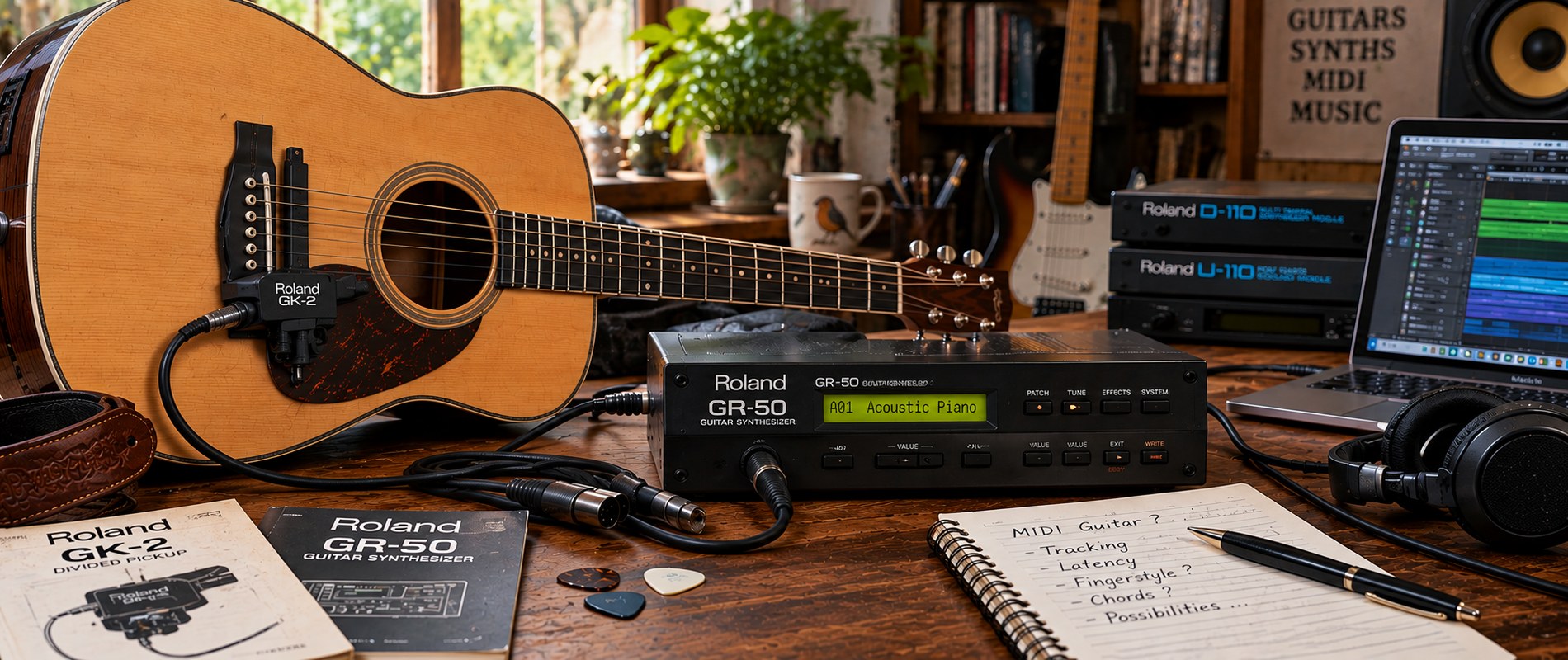
MIDI guitar has been one of those ideas that has promised to let a guitarist play virtually any electronic instrument from the guitar itself. I first experimented with it in the 1980s. The technology has changed enormously since then, but the basic problem has not disappeared: a guitar produces a much more complicated signal than a keyboard key, so the system has to work out what the guitarist actually played before it can generate MIDI.
My MIDI Guitar Experiment in the 1980s
My own experiment used a Fender Squier fitted with a Roland GK-2 hexaphonic pickup. I tried various Roland synthesiser and sample-based sound boxes, including systems where cards containing different groups of sounds could be plugged into the unit. It was fascinating technology and the range of sounds available from a guitar was impressive.
The disappointment came when I tried to use it for the music I actually wanted to play. Single-string lines could be reasonably successful, but moving into fingerstyle was another matter. Dropped notes, unwanted notes, and problems caused by fretting, releasing and repositioning fingers made the system increasingly difficult to use. The more independent information there was being played by the two hands, the harder it seemed for the system to decide what was intended.
The original version of this page also recorded the contemporary experience of a Roland GK-2 being used with a later Roland system in the late 1990s, where the tracking appeared considerably better. That historical observation is worth retaining, but it should not be confused with a modern hands-on assessment.
What Is MIDI Guitar?
MIDI itself is not sound. It is a communications protocol carrying musical information such as note number, note-on/note-off, velocity and controller data. A guitar-to-MIDI system therefore has to listen to the guitar and translate its audio into control information.
With a keyboard, a switch or sensor gives the instrument a comparatively unambiguous indication that a particular key has been pressed. A guitar string produces a continuously changing waveform, with a complicated attack and many additional vibrations. The system therefore has to infer pitch and other playing information from the audio. That process inevitably introduces compromises, particularly at lower pitches and during complex playing. Sound On Sound's technical explanation of guitar-to-MIDI describes the relationship between waveform analysis, pitch recognition and tracking delay in detail.
Why Guitar-to-MIDI Is Difficult
The fundamental problem is still recognisable from the difficulties I encountered decades ago. A guitar note does not arrive as a neat digital command saying "play this note". The system has to recognise what happened in the acoustic signal.
| Problem | What the system has to deal with | Why it matters to fingerstyle |
|---|---|---|
| Pitch recognition | The software has to establish the pitch from the string waveform. | Lower notes take longer to establish accurately, and rapid playing leaves less time for analysis. |
| Attack and transient information | The beginning of a plucked note contains complex, non-steady-state information. | Fingerstyle produces many different attacks from thumb, fingers and nail, sometimes almost simultaneously. |
| Polyphony | Several strings may be sounding at once and the system has to separate the musical events. | Alternating bass, melody and chord fragments can produce a particularly busy signal. |
| Unwanted triggering | String noise, finger movement, fret noise and changes of pressure can be mistaken for notes. | Fingerstyle involves frequent left-hand movement and string contact that is musically harmless but acoustically detectable. |
| Latency | The system cannot always output a MIDI event until enough information is available to identify the note. | Even small delays become noticeable when playing tightly timed bass-and-melody arrangements. |
How Modern Systems Differ
There are now two broad approaches. One continues the traditional hexaphonic/divided-pickup method, in which each string is sensed separately. The other analyses the ordinary guitar audio signal using software. The latter approach means that a conventional guitar can sometimes be used without fitting a special MIDI pickup.
| Approach | Current example | Special pickup? | Basic principle |
|---|---|---|---|
| Guitar synth with divided pickup | BOSS GM-800 | Yes | Individual string signals from a compatible GK pickup are processed for guitar-synth control. |
| Hex pickup plus computer software | JAM Origin MIDI Guitar 3 Hex | Yes | Hexaphonic signals are processed separately, extending the software approach with per-string information. |
| Ordinary guitar plus computer software | JAM Origin MIDI Guitar 3 | No | The normal guitar audio output is analysed in real time and converted to standard MIDI or MPE. |
| Dedicated wireless MIDI controller | Fishman TriplePlay | Yes | A mounted hexaphonic pickup/controller detects the strings and sends MIDI to computers and compatible equipment. |
So — Is MIDI Guitar Now Suitable for Fingerstyle?
The answer is more nuanced than either "yes" or "no". Modern systems are substantially more sophisticated than the systems available when I first experimented with MIDI guitar. They can handle polyphonic playing and, depending on the system, can work from either a conventional guitar signal or separately sensed strings.
However, the fundamental tracking problem has not vanished. Current manufacturers themselves acknowledge that pitch-to-MIDI systems still involve compromises, while technical testing and explanation from Sound On Sound continues to identify unwanted triggers, playing technique and the inherent need to analyse a guitar waveform as important factors. In other words, modern MIDI guitar should not be regarded as a perfect electronic replacement for the guitarist's fingers.
For a fingerstyle player, the important questions are likely to be:
- How cleanly does it follow simultaneous bass and melody?
- How does it behave with rapid alternating-bass patterns?
- Does it generate unwanted notes when fingers are lifted?
- How well does it handle hammer-ons, pull-offs, slides and vibrato?
- How much latency is noticeable on the lower strings?
- Does it remain reliable when several strings are sounding together?
- How much MIDI editing is required after recording?
Those are exactly the sorts of tests I would want to make before deciding whether a modern system was genuinely useful for the kind of fingerstyle, ragtime and country-blues playing covered elsewhere on these pages.
Where Modern MIDI Guitar Could Be Useful
MIDI guitar is not limited to making a guitar sound like a synthesiser. MIDI output can be used to control virtual instruments, record MIDI into a DAW, drive external sound modules, experiment with arrangements, and generate musical parts that would otherwise have to be entered on a keyboard or programmed manually.
There is also a creative advantage to controlling another instrument from a guitar. Guitarists naturally voice chords and melodic phrases differently from keyboard players, so the resulting MIDI performance can retain a distinctly guitaristic character. Pitch bends and vibrato can also be musically useful when the receiving instrument responds appropriately.
My View: Then and Now
My experience in the 1980s left me with the impression that MIDI guitar was an intriguing technology looking for a way around a very difficult engineering problem. It worked sufficiently well to demonstrate the idea, but the limitations became obvious as soon as I tried to use it for fingerstyle rather than simple single-note playing.
The technology has moved on considerably. What has changed most radically is not just the processing power available, but the availability of sophisticated software that can analyse ordinary guitar audio, alongside much better divided-pickup systems. I have not personally tested the current generation, however, so this updated page is deliberately an explanation of where the technology is now rather than a claim based on my own recent hands-on experience.
If I ever return to MIDI guitar, the first test I would make would not be a simple single-note scale. It would be one of my normal fingerstyle arrangements: alternating bass, independent melody, chord changes, hammer-ons and pull-offs, and all the little movements that happen naturally in real playing. That would give a much more meaningful test of whether the technology has crossed the gap that frustrated me originally.
Further Reading & Current Resources
- JAM Origin — MIDI Guitar 3: current software-based guitar-to-MIDI system; no special pickup required.
- JAM Origin —s: current version information, including the stable MIDI Guitar 2 release and the MIDI Guitar 3 beta releases.
- JAM Origin — MIDI Guitar 3 Hex: the hexaphonic version for per-string processing.
- BOSS GM-800: current Roland/BOSS guitar synthesiser using the modern serial GK pickup system.
- Fishman TriplePlay: current dedicated hex-pickup MIDI guitar controller range.
- Sound On Sound — Guitar To MIDI Explored: useful technical explanation of pitch tracking, latency, unwanted triggering and the difference between keyboard and guitar input.
Research note — 18 September 2026: current product information on this page was checked against the manufacturers' current documentation and the Sound On Sound technical article cited above. Product availability, software versions and specifications can change, so the linked manufacturer pages should be treated as the current source for those details.
Related Guitar Pages
Guitar Equipment & Choosing the Right Gear —
guitars, strings, capos, tuners and accessories.
Software for Music Transcribers —
transcription, audio slowdown, TablEdit and notation software.
My Tabs —
Steve's fingerstyle, ragtime, blues and folk arrangements.
Ragtime, Blues & Folk Guitar —
background and resources for the styles central to these Guitar Pages.


