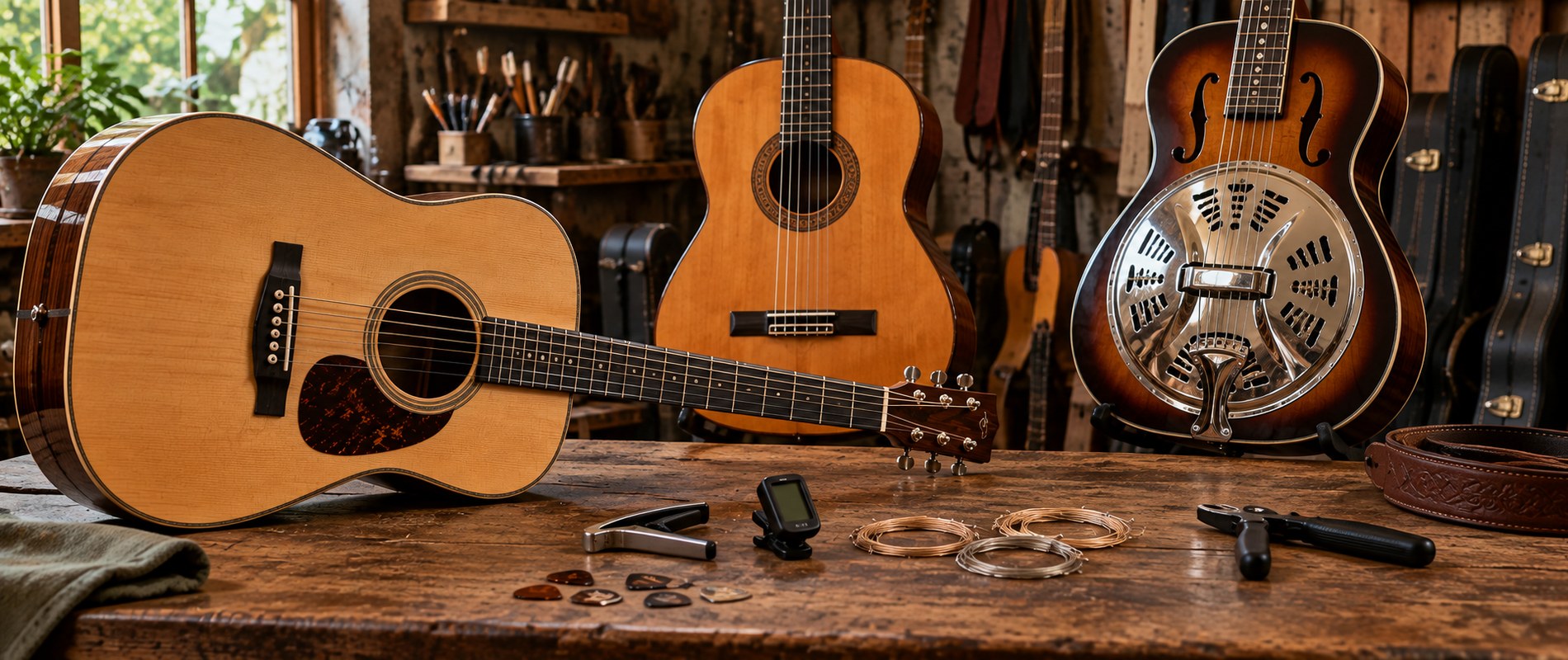
The Guitar & Music Weekends described here took place in the past. I have not attended one for many years and I do not know whether Joe Cainen continues to organise similar events. This page is therefore retained as a historical record of the weekends, their activities and traditions, rather than as a source of current dates, prices, accommodation or booking information.
The Guitar & Music Weekends
The original page described a series of singing, guitar-playing and general music weekends held at Savio House, Bollington, near Macclesfield, Cheshire. The weekends were associated with Joe Cainen and followed earlier events at other residential centres, including Spode House, the Maryvale Centre and Dehon House.
What made the weekends memorable was not simply the formal music-making. They brought together people who played guitars, sang, exchanged tunes and tablature, helped one another with playing, formed small groups and joined in with whatever music was happening around them. The atmosphere described on the original page was informal, sociable and deliberately inclusive.
A Weekend at Savio House
Friday evening
People generally arrived around 6:00–7:00pm, with later arrivals inevitable because of work and travelling. After tea, the first session began with communal songs and tunes, followed by a round-robin in which people took turns to play or sing — or simply pass if they did not feel like performing.
The original account mentions around twenty guitars on some weekends, together with instruments such as clarinet, flute, penny whistle, mandolin and banjo. Sessions could continue late into the night.
Saturday
Saturday was the main working and playing day. Groups formed to practise, pass tunes and tablature around, and help one another. The original account also describes small-group teaching, folk dancing, barbershop singing and preparation for group performances during the Saturday evening session.
The evening combined those prepared group performances with individual and group contributions in the usual informal sing-around.
Sunday
Sunday followed a similar pattern but was generally quieter after the previous evening. The final session began after lunch and continued until roughly 4:00–4:30pm, when people departed for home.
The original description captures the characteristic end to the weekend: people leaving with plenty of friendly banter, hand-waving and, inevitably, tunes still running through their heads on the journey home.
Playing, Learning and Sharing
The weekends were particularly interesting from a guitarist's point of view because there was no single formal teaching programme. Instead, learning happened naturally through playing with other people. Players passed tunes around, shared tablature, demonstrated techniques and worked on arrangements together.
The original account also notes that newcomers were welcome and that people could attend for different parts of a weekend. That flexibility was part of the informal character of the gatherings.
The Wider Weekend Tradition
The Bollington weekends were part of a longer-running series of music weekends. The original page specifically mentions earlier ventures at Spode House, the Maryvale Centre and Dehon House, before the weekends became associated with Savio House at Bollington.
Savio House was described at the time as being just outside Bollington, about five miles north of Macclesfield, in spacious grounds bordering the Peak District National Park. The original page also described its residential accommodation and its accessibility from surrounding towns and cities. Those details are retained here only as historical context and should not be taken as current information about the venue.
Bollington Weekend History
| Weekend | Historical date recorded on the original page | Location / description |
|---|---|---|
| Bollington 36 | 30 April – 2 May 2010 | Savio House Weekend |
| Bollington 37 | 15 – 17 October 2010 | Savio House Weekend |
The “Irene, Goodnight, Appreciation Society” — IGAS
One of the traditions that developed around the music weekends was the singing of Leadbelly's Irene, Goodnight Irene at the end of the Saturday evening sing-around. This developed its own informal group or “Society”, with a drink to “Irene” at the nearby pub becoming part of the tradition.
The name Irene, Goodnight, Appreciation Society produced the acronym IGAS. The original page described the Society as a mixture of genuine tradition and humour, and linked to a separate IGAS website containing information about the Society and Leadbelly.
Joe Cainen's Historical Notes
The original page included a substantial set of comments attributed to Joe Cainen. They described the emphasis of the Folk Music Weekend as providing opportunities for dance and song in a relaxed and informal atmosphere, with guitar workshops, barbershop singing and activities suitable for beginners as well as more experienced players.
Those comments also described the weekend as open to newcomers and gave historical information about Savio House, its accommodation, the surrounding area and arrangements for attending. Because the page is now an archive, the original booking address, telephone number, prices, mailing-list instructions and other time-sensitive practical details have deliberately been removed.
Why Keep the Page?
Although these weekends are no longer part of my current activities, I think the page is worth retaining because it records a particular kind of informal acoustic-music gathering: people meeting to play, sing, learn from one another, exchange tablature and spend a weekend immersed in music.
It is therefore best regarded as a small piece of the history of the acoustic-guitar and folk-music activities with which I was involved, rather than as an events resource requiring regular maintenance.


