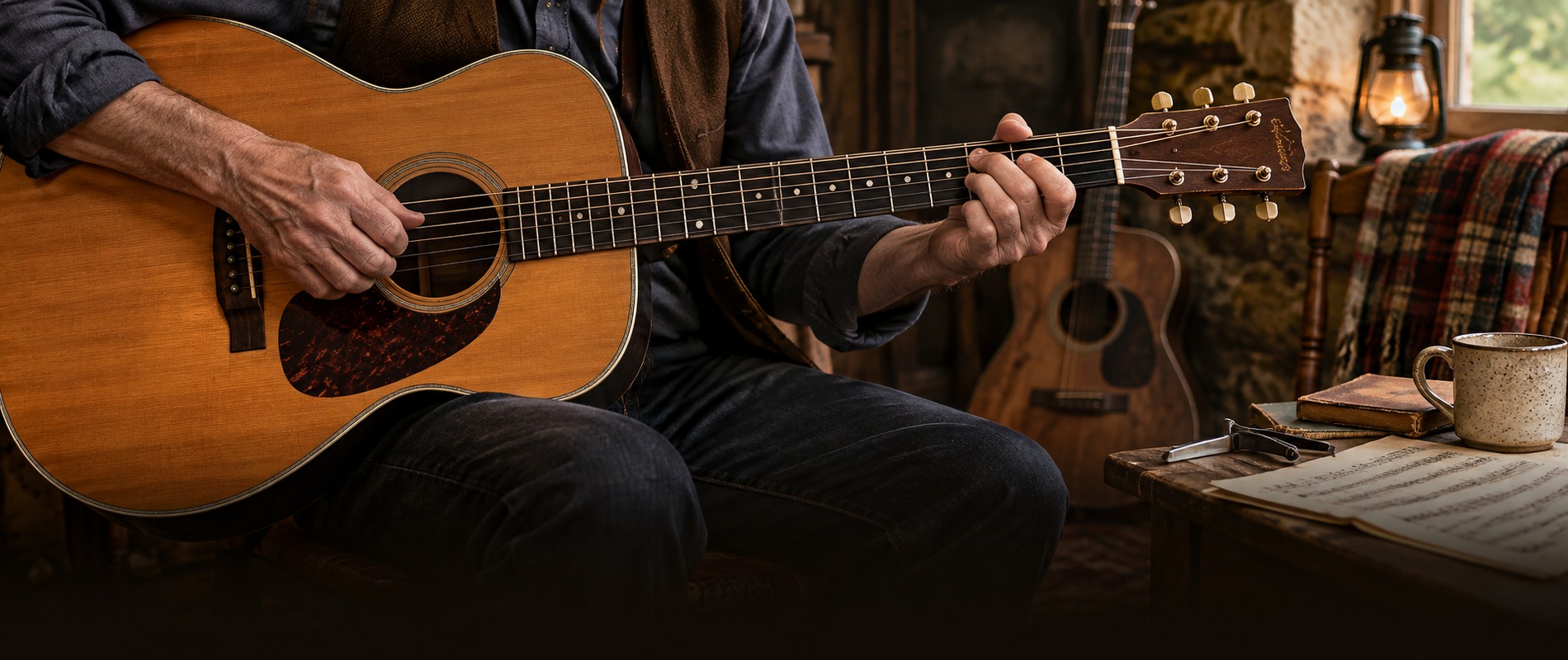
Three closely related traditions — and three rather different ways of making a guitar sound
Ragtime, blues and folk guitar overlap enormously. All three have produced important fingerstyle traditions in which a single acoustic guitarist can provide rhythm, bass, harmony and melody at the same time. Yet they have different histories, musical priorities and ways of using the instrument.
This page is concerned principally with acoustic guitar, and particularly with the solo player: the guitarist who does not need a backing band to make the music work. That includes instrumental playing, as well as singers who accompany themselves on guitar.
The three genres
Ragtime
Ragtime began principally as an American piano tradition, famous for its syncopated melodies and strong underlying pulse. On guitar, the challenge is to transfer that independent, multi-part character to six strings: an alternating or walking bass, chordal support and a syncopated melody must sound as though several parts are being played simultaneously.
Blues
Blues is rooted in African-American musical traditions and has an enormous range of forms. Country and acoustic blues guitar often combines a repeating bass with melody, vocal lines, chordal responses and rhythmic accents. Blue notes, slides, bends, call-and-response phrasing and expressive timing are especially important.
Folk
Folk is the broadest of the three terms. It encompasses traditional songs and instrumental music, regional traditions and later singer-songwriters and revivalists. Acoustic guitar may simply accompany a voice, but the fingerstyle tradition also turns melodies, harmonies and rhythms into complete solo arrangements.
Ragtime guitar — two rather different traditions
It is important not to reduce ragtime guitar to guitar arrangements of piano rags. There certainly is a substantial tradition of taking the compositions of Scott Joplin, James Scott and Joseph Lamb and arranging them for one or two guitars. But there is another, historically important guitar-native tradition which is ragtime in its own right: the highly syncopated fingerstyle of the American East Coast and Piedmont.
Blind Blake is the essential starting point. His recordings include pieces actually labelled Southern Rag, and the wider East Coast repertoire includes guitar rags alongside blues, dance music, popular song and gospel. Blind Boy Fuller, Reverend Gary Davis, Willie Walker and other East Coast players developed related approaches. Their music is often called Piedmont blues or East Coast blues, but that label can obscure how much of the repertoire is built from ragtime rhythm and fingerstyle technique rather than from the Mississippi Delta blues vocabulary alone.
In this tradition the thumb is effectively the bass player. It may alternate or walk between bass notes while the fingers play syncopated treble lines, chord fragments, fills and sometimes a second melody. The result can sound almost like a small ensemble or a piano played on six strings. This is why calling Blind Blake or Blind Boy Fuller simply “country blues” is technically defensible but musically incomplete: they belong to a distinct East Coast/Piedmont fingerstyle world with a strong ragtime identity.
The distinction from the classic Delta approach is therefore worth making. Delta guitar developed its own powerful vocabulary of drones, bottleneck slide, repeated bass figures, vocal-like phrasing and percussive attack. Piedmont playing more often uses alternating-thumb fingerpicking, syncopated melody, chordal movement and the independence of several voices. The two traditions overlap and individual musicians do not obey geographical boundaries, but they are recognisably different guitar languages.
Piedmont ragtime and the parlour-guitar connection
There is an even earlier layer which is easily missed. Nineteenth-century parlour guitar produced instrumental pieces that pre-date ragtime as a named musical movement but contain some of the ingredients later heard in ragtime and fingerstyle guitar: repeated basses, independent treble melody, syncopated figures, chordal movement and dance-like rhythm. Henry Worrall's Sebastopol, published for solo guitar in 1860, is a particularly important example. It was a popular parlour piece, written in Open D, and the name subsequently became associated with the tuning — hence Vestapol/Vastapol.
It would be anachronistic to call Sebastopol “ragtime” in the strict historical sense: it predates the ragtime era. But in a broader guitar-playing sense, some of this parlour repertoire can reasonably be regarded as proto-ragtime or part of the prehistory of ragtime fingerstyle. The important point is that the guitar already had a repertoire of solo, rhythmically active, multi-voiced music before players such as Blind Blake brought the East Coast ragtime/blues language to the recording era.
That makes the later history much more interesting. The line is not simply Scott Joplin piano → guitar arrangement. It is also nineteenth-century parlour guitar → open tunings and fingerstyle practice → ragtime-influenced East Coast guitar → Piedmont blues and ragtime guitar. The strands continually cross-fertilised one another.
The parallel piano-rag route
A different development took place when later guitarists deliberately tackled the problem of putting complete composed piano rags onto the guitar. Reverend Gary Davis had already been wrestling with this problem, and the 1960s folk revival brought renewed attention to ragtime guitar. David Laibman began working on ragtime guitar arrangements in the 1960s and started playing rags with his cousin Eric Schoenberg in 1966. Their landmark album The New Ragtime Guitar was recorded and released in 1971 by Folkways. It included Scott Joplin's Maple Leaf Rag, Stoptime Rag and other classic rags.
Laibman and Schoenberg's achievement was important because they treated the piano repertoire as a serious transcription problem rather than merely borrowing a ragtime feel. Their own notes explain that a six-string guitar cannot simply reproduce everything written for an 88-key piano; they developed arrangements, including two-guitar arrangements, that retained the characteristic bass, harmony, melody and syncopation while making the music work as guitar music. The later Kicking Mule recordings helped establish modern “ragtime guitar” as a recognised fingerstyle discipline.
Reverend Gary Davis sits interestingly between the two streams. His playing belongs firmly to the East Coast/Piedmont fingerstyle world, but he also tackled recognisable classic ragtime material. His ragtime repertoire includes St. Louis Tickle, Italian Rag, Cincinnati Flow Rag and Make Believe Stunt. The title is sometimes misremembered as “Make Believe Stomp”; the documented title is Make Believe Stunt. His approach to Maple Leaf Rag material is an important example of the two traditions meeting in one player.
So there are really two historical streams worth keeping in view: the older guitar-native ragtime of the Piedmont/East Coast fingerpickers, and the later conscious transcription of classic piano rags for guitar. Modern players frequently draw on both.
On a solo guitar the piano-derived approach commonly means a strong bass part under a highly syncopated treble. The Piedmont approach can achieve a similar illusion of several instruments, but its language is more closely related to fingerpicking, dance accompaniment, blues, gospel and popular song. Both are worth calling ragtime guitar; they simply arrive there by different historical routes.
There is also a very important ragtime-blues or “ragtimey” tradition. Here the guitarist is not trying to reproduce a Joplin piano rag literally. Instead, the syncopated feel of ragtime is combined with country-blues harmony, alternating bass, fingerpicking and blues phrasing. Blind Blake, Blind Boy Fuller and Rev. Gary Davis are central historical examples. This is one of the places where the supposed boundary between ragtime and blues becomes particularly thin.
Blues guitar — rhythm, voice and guitar becoming one instrument
Acoustic blues guitar can range from very simple vocal accompaniment to extremely sophisticated solo fingerstyle. In the latter, the guitarist effectively supplies the backing band: the thumb maintains bass and rhythm while the fingers add treble lines, chord fragments, fills and answers to the sung phrase.
Common ingredients include call and response, repeated or modified vocal lines, blues harmony, syncopation, slides and bends, altered or “blue” notes, and a strong sense of groove. Twelve-bar blues is enormously important, but it is not the definition of blues: many blues performances use different lengths, progressions and song forms.
For the solo acoustic player, open tunings can be particularly useful. They allow sustained bass notes and ringing chord shapes while leaving the fretting hand free for melodic movement, slides and embellishment. Standard tuning is equally capable of producing sophisticated fingerstyle blues.
Folk guitar — the broadest territory
“Folk” is difficult to define precisely because it describes both a way in which music is transmitted and a large family of musical traditions. Traditional British and Irish music, American old-time music, ballads, blues-influenced folk, singer-songwriter material and contemporary acoustic instrumental music can all sit under the folk umbrella.
For the solo guitarist, folk playing often places the tune itself at the centre. A player may arrange a traditional melody so that the bass, harmony and melody all sound together, or use the guitar primarily to support a sung narrative. Fingerpicking, alternating bass, crosspicking, dropped tunings and open tunings are all common, but there is no single “folk guitar technique”.
British and Celtic fingerstyle provides a particularly interesting example. A guitarist such as Tony McManus can transfer the ornamentation and phrasing of fiddle, whistle and piping traditions to the guitar. DADGAD and other altered tunings can give the instrument the open strings and drone-like resonance associated with those traditions.
So what actually differentiates them?
| Feature | Ragtime | Blues | Folk |
|---|---|---|---|
| Main musical emphasis | Syncopation and independent bass/melody parts. | Groove, phrasing, expression and call-and-response. | Melody, song, story, tradition and regional style. |
| Typical solo-guitar effect | A miniature piano: bass underneath a busy, syncopated treble. | A miniature band: bass, rhythm, vocal responses and fills from one guitar. | A complete arrangement of a tune, accompaniment to singing, or an instrumental interpretation. |
| Rhythm | Strong regular pulse with displaced or syncopated melody. | Often strongly rhythmic and swinging, with flexible timing and accents. | Highly variable: from steady song accompaniment to dance rhythms and free, rubato arrangements. |
| Harmony | Often chord-rich and structurally regular; classic rags follow composed forms. | Frequently based on blues progressions, but with much wider harmonic variety than the standard 12-bar model. | Determined by the particular tradition, song or arranger; can be very simple or harmonically elaborate. |
| Characteristic techniques | Alternating bass, syncopated treble, counterpoint, chord-melody arrangements. | Fingerpicking, alternating bass, slide, bends, hammer-ons, pull-offs and vocal responses. | Fingerpicking, flatpicking, crosspicking, drones, altered tunings, ornamentation and accompaniment. |
Living and currently active players to explore
The following is a selected listening list, not a ranking. I have concentrated on players whose work gives the acoustic guitar a substantial solo role, rather than simply listing famous musicians who happen to have played some folk, blues or ragtime.
Piedmont and traditional fingerstyle — living players carrying the tradition forward
A note on the older masters: Blind Blake, Blind Boy Fuller, Reverend Gary Davis, Willie Walker, Blind Willie McTell, John Jackson, Archie Edwards, John Cephas and other foundational players are treated here as historical sources of the tradition rather than as current performers. Their recordings remain essential listening because the distinction between “Piedmont blues”, “ragtime guitar”, “songster” and “folk” is often much clearer in the music than in modern genre labels.
Ragtime and ragtime-influenced fingerstyle
Acoustic and country blues
Folk and contemporary acoustic fingerstyle
Where the three traditions meet
The most interesting acoustic guitar music often occurs in the overlap. A player may use a blues thumb pattern, add the syncopation of ragtime, take the melody from a folk song, and then use an altered tuning to make the whole arrangement practical on six strings.
That crossover is not a modern invention. The history of fingerstyle guitar is full of musicians borrowing ideas from neighbouring traditions. Ragtime guitar itself became intertwined with country blues; the folk revival absorbed blues and ragtime fingerpicking; and later acoustic guitarists such as Martin Simpson, Pierre Bensusan, Duck Baker and Richard Gilewitz have treated the instrument as a vehicle for arranging music rather than as a device belonging to one genre.
For a solo player, this is perhaps the most useful way to think about the three styles. Ragtime teaches independence and syncopation; blues teaches groove, phrasing and expressive response; folk teaches arrangement, melody and the relationship between the guitar and the song. The techniques can then be combined in almost limitless ways.
Ralph Towner — an important recent figure
Contemporary acoustic guitar — beyond the old genre boundaries
The modern acoustic-guitar scene has taken the idea of the solo guitarist-as-ensemble much further. Contemporary fingerstyle players still use the older ingredients — alternating bass, finger independence, open and altered tunings, melody with harmony and rhythm — but they increasingly combine them with techniques that would not have been part of the traditional ragtime, Piedmont or folk vocabulary.
Tapping is one obvious example. Two-handed tapping, hammer-ons and pull-offs across the neck can allow the fretting hand to contribute independent rhythmic or melodic material while the picking hand supplies other voices. Percussion on the soundboard, sides and back of the instrument adds kick-drum, snare and other effects; harmonics, slaps, body hits, partial capos, unusual tunings, looping and amplification can extend the palette still further. These techniques are not simply tricks: in the best contemporary work they are compositional tools used to create several simultaneous musical layers from one instrument.
Preston Reed was an important pioneer of integrated percussive acoustic guitar in the late 1980s and 1990s. His own account describes combining two-handed hammer-ons and pull-offs with fingerpicking, and subsequently integrating neck and body percussion into complete rhythmic grooves. Andy McKee brought a related approach to a much wider online audience, while players including Don Ross, Jon Gomm, Mike Dawes, Kaki King, Antoine Dufour, Christie Lenée and Alexandr Misko have taken contemporary fingerstyle in different directions. Their music ranges from folk and blues-derived material through jazz, rock, pop, classical and entirely original instrumental forms.
There is therefore no single “modern fingerstyle” sound. Tommy Emmanuel represents one highly developed route from traditional fingerstyle, country, blues and jazz into sophisticated solo performance; Don Ross combines fingerstyle with altered tunings, groove and influences from blues, jazz, folk and classical music; Andy McKee uses altered tunings, tapping, partial capos and body percussion; Jon Gomm integrates melodic two-hand tapping, harmonics and guitar drumming; and Alexandr Misko is exploring elaborate multi-pickup and built-in-percussion instruments as well as intricate fingerpicking. The common thread is not genre but the continuing attempt to make a single acoustic guitar perform functions traditionally divided among several musicians.
That is also why the modern scene belongs on a page about ragtime, blues and folk. The technology and techniques have changed, but the underlying idea is remarkably old: make the guitar carry more than one musical voice at once. The alternating thumb of Blind Blake and the two-handed tapping of a contemporary player are separated by a century, but both are solutions to the same fundamental solo-guitar problem — how to make six strings sound like more than one instrument.
Further listening and sources
The player information above was checked against current artist or specialist sources in September 2026. “Current” means living and demonstrably active or maintaining a current professional/educational presence; the list is intentionally selective rather than exhaustive.
- Smithsonian Folkways — John Jackson: Piedmont bluesman — useful description of the fingerpicked, melody-centred Piedmont style and its distinction from Delta blues.
- Smithsonian Folkways — Piedmont Blues and Beyond — historical background on the regional mixture of blues, ragtime, jazz, country, gospel and popular song.
- Smithsonian Institution — Ragtime in Rural America — catalogue evidence for guitar rags including Blind Blake's Southern Rag and Blind Boy Fuller's Piccolo Rag.
- Kansas Historical Society — Henry Worrall Collection — history of Sebastopol, Worrall's solo guitar work, Open D and the later “Vastopol” tuning name.
- Stefan Grossman's Guitar Workshop — fingerstyle, country blues and ragtime resources.
- Duck Baker — current recordings, discography and biography.
- Catfish Keith — acoustic country blues, slide and solo guitar.
- Rory Block — traditional country blues and acoustic guitar.
- Eric Bibb — blues, roots and acoustic guitar.
- Martin Simpson — English folk, fingerstyle guitar and tablature.
- Pierre Bensusan — acoustic fingerstyle, folk and DADGAD.
- Tony McManus — Celtic acoustic guitar and solo fingerstyle.
- Richard Gilewitz — solo fingerstyle across folk, blues and ragtime.
- Richard Smith — British solo fingerstyle, including Scott Joplin ragtime arrangements.
- Ralph Towner — classical and 12-string guitar, jazz, composition and solo acoustic work.
- Clive Carroll — contemporary British acoustic guitarist and composer.
- Peter Finger — German acoustic guitarist, composer and long-standing fingerstyle performer.
- Preston Reed — integrated percussive acoustic guitar and two-handed techniques.
- Andy McKee — contemporary acoustic guitar using altered tunings, tapping and percussion.
- Jon Gomm — melodic two-hand tapping, harmonics and integrated percussion.
- Don Ross — groove-based contemporary fingerstyle and altered tunings.
- Alexandr Misko — modern fingerstyle, integrated percussion and experimental guitar design.
- Antoine Dufour — contemporary acoustic fingerstyle.
- Mike Dawes — contemporary progressive fingerstyle, tapping and percussive acoustic guitar.
- Kaki King — contemporary acoustic guitar, composition and multimedia performance.
- Tommy Emmanuel — contemporary solo acoustic guitar and fingerstyle performance.
- Christie Lenée — contemporary fingerstyle combining acoustic tapping, percussion and songwriting.
- Don Ross — Bandcamp — listening and streaming from Don Ross's catalogue.
- Country Music Hall of Fame — Jerry Reed — includes playable recordings including The Claw, East Bound and Down and Lord, Mr. Ford.
- Chet Atkins — Spotify — streaming catalogue of Chet Atkins recordings.
- Adam Rafferty — Activity / Watch Now — performances and music videos.
- Igor Presnyakov — Official Website — official artist site and gateway to his performance material.
- Adrian Legg — Bandcamp — streaming catalogue of Adrian Legg recordings.
- Maneli Jamal — Music — music catalogue with embedded listening players.
- Alex de Grassi — Bandcamp — streaming catalogue including The Water Garden, Tatamonk and other recordings.
This page deliberately concentrates on acoustic guitar. Electric blues, jazz guitar, bluegrass ensemble playing and classical guitar are important neighbouring traditions, but they are outside its main purpose.


