Steve McWilliam's Acoustic Guitar Teaching — A Retrospective
What I Taught
The focus was acoustic guitar, particularly the various forms of fingerstyle playing sometimes described as finger-picking, alternate-bass style, Travis picking, thumb-and-fingers, or — less helpfully — clawhammer. The musical material came mainly from the traditions of ragtime, country blues and folk music, using tunes, songs and instrumental pieces.
The emphasis was practical: learn the music by playing it, understand what the right hand and left hand are doing, and gradually build the coordination needed to make the arrangement sound musical rather than simply reproducing a sequence of notes.
| Area | Typical emphasis |
|---|---|
| Fingerstyle technique | Thumb-and-fingers coordination, alternating bass, melody against accompaniment and independent voices. |
| Ragtime | Syncopated melody, alternating-bass patterns and the coordination required to keep the bass moving while the melody remains clear. |
| Country blues | Blues phrasing, bass patterns, chord shapes, rhythmic variation and the use of open and altered tunings where appropriate. |
| Folk guitar | Accompaniment, instrumental arrangements and fingerstyle approaches to traditional and contemporary material. |
| Tablature | Reading and writing guitar TAB as a practical way of communicating fretted-string music without requiring standard notation. |
Why Tablature Was Central to the Lessons
The original teaching page deliberately stressed tablature. For acoustic guitar, TAB can show exactly which string and fret are required, and it can represent simultaneous bass, melody and accompaniment in a way that is immediately tied to the instrument.
That made it particularly suitable for the fingerstyle arrangements being taught. Students did not need to learn standard musical notation before they could start working on the guitar. The aim was to get useful musical information onto the page in a form that could be translated directly into finger movements.
That approach also connects directly with the My Tabs section of this site, where many of Steve's arrangements are available in TablEdit format.
A Practical Learning Approach
A fingerstyle arrangement can look deceptively complicated on paper because several things happen at once. A useful way of learning is to separate those elements and then put them back together:
- Establish the tuning and any capo position before starting.
- Learn the chord shapes and left-hand movements that form the harmonic framework.
- Work on the alternating bass until it becomes steady and automatic.
- Learn the melody independently, paying attention to phrasing rather than simply playing every note with equal weight.
- Combine bass and melody slowly, then add the remaining accompaniment notes.
- Use repeated short passages rather than repeatedly playing the whole arrangement from the beginning.
- Gradually increase tempo only after the movement between the parts is reliable.
This is particularly relevant to ragtime and country-blues fingerstyle, where the thumb may need to maintain a regular bass while the fingers produce a much less regular melody and syncopated accompaniment.
Styles and Repertoire
The teaching repertoire centred on acoustic music rather than a single narrowly defined genre. Ragtime, country blues and folk overlap considerably in their guitar techniques, and material from one tradition can be useful for learning techniques associated with another.
| Style | What it can teach the player |
|---|---|
| Ragtime fingerstyle | Alternating bass, syncopation, chord-melody playing and independence between thumb and fingers. |
| Country blues | Blues vocabulary, rhythmic flexibility, bass patterns, slides and the expressive use of open tunings. |
| Folk fingerstyle | Melody-and-accompaniment arrangements, traditional tunes, song accompaniment and adaptable picking patterns. |
| Instrumental arrangements | Turning a tune normally associated with another instrument or ensemble into a self-contained guitar arrangement. |
The Teaching Page Lives On Through the Guitar Pages
Although the lessons have stopped, much of the material that grew out of this period remains useful. The site's My Tabs, Friends' Tabs and Duet Tabs pages contain arrangements in TablEdit format, while the Ragtime, Blues & Folk page provides background to the musical traditions that informed the teaching.
The Software for Music Transcribers page explains the tools used for slowing down recordings, analysing passages and preparing tablature or notation. For anyone studying the arrangements on this site, these resources provide a practical way of exploring the music even though face-to-face lessons are no longer available.
A Note on the Original Page
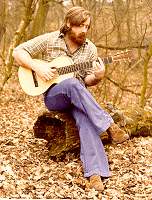
The photograph reproduced here was the image used on the original teaching page. It shows Steve playing a Bill Dinsdale Parlour model, with maple back and sides and a spruce top, in Halton Wood, Runcorn. Steve was probably in his mid-to-late twenties at the time.
The photograph was taken during a day in the woods with Mike Martin, Chris Cassidy and Kieran Fish (later Kieran Carr). The original page dated the image circa 1982, but the present description uses the approximate age recalled for the photograph rather than treating that old date as certain.
The old page also described private pupils, paired lessons and evening classes at Halewood Comprehensive in Liverpool. Those statements are historical now and have deliberately been removed from the current page as descriptions of present-day services.
The old page also suggested lessons by Internet or post. Steve's actual teaching was face-to-face, and he never developed an online teaching service. The revised page therefore records the teaching approach without implying that lessons are currently available in any format.
